If you have a child who is constantly humming or singing tunes as they go about their everyday activities, you may have a vocalist-in-the-making. You might even be wondering if you should begin honing this skill with voice lessons.
Especially if your child is young, you may be wondering what age is best to start voice lessons. You want to encourage their interest, but you also want them to stick with voice lessons and enjoy them.
Voice lessons can be beneficial for everyone, but you want to make sure your child is developmentally prepared for what voice lessons may involve. Keep reading to learn when it’s recommended for children to begin taking voice lessons, signs your child might be ready, what voice lessons include, and how you can get started with quality voice lessons at Northwest School of Music.
Table of Contents
- What Is the Best Age To Start Voice Lessons?
- Signs Your Child Is Ready To Take Voice Lessons
- What Children’s Voice Lessons May Include
- Are Voice Lessons Good for Kids?
- 5 Benefits of Voice Lessons for Children
- Start Your Child’s Singing Journey With the Skilled and Experienced Instructors at Northwest School of Music
What Is the Best Age To Start Voice Lessons?
Deciding when a child is ready to take voice lessons can depend on various factors, like their physical development, motivation, and interest. In general, most music professionals believe children should start voice lessons somewhere between the ages of seven and ten.
There are some who think it’s best for girls to start voice lessons after 12 years old and boys after 15 years old. Their reasoning revolves around the changes in the larynx and vocal cords during puberty. If you want to begin intense voice lessons, it may be best to wait until they are a little older.
We believe voice lessons can be enjoyable for younger children who want to explore singing without the pursuit of the rigor involved in more focused lessons. Young children can learn to sing safely and beautifully while also learning basic musicianship and self-expression.
Voice lessons can be beneficial for all ages, especially with an experienced instructor who will know what each student needs and is capable of.
You’ll find those kinds of voice instructors at Northwest School of Music. With our team of educated and skilled instructors, we’re sure you’ll easily find the instructor to help your child start their musical journey.
Signs Your Child Is Ready To Take Voice Lessons
Is your child always singing around the house, mimicking their favorite songs, or showing a natural curiosity for music? These could be signs they’re ready to take voice lessons! Whether they’re belting out tunes with confidence or simply humming quietly, recognizing the early signs of musical interest can help you nurture their talent and know what age to start voice lessons.
Development of the Physical Motor Skills for Singing
Before beginning voice lessons, you want to make sure your child is physically up to the task. The following fine motor skills are used in singing:
- Breath control – Singing requires controlled diaphragmatic breathing and the use of other muscles.
- Vocal cord control – This requires moving vocal cords to produce different tones and pitches.
- Jaw, throat, and tongue coordination – The shaping and coordinated movement of these three body parts is key for articulation and vowel production.
- Resonance – This involves the way the sound vibrates in the chest, throat, and head.
- Auditory coordination – This requires listening to your own voice and making adjustments accordingly.
Assess your child using this list to see if they are ready to get started with voice instruction or if they need a little more physical maturing.
Motivation
Motivation and desire go a long way.
If your child isn’t showing any interest, it’s probably a good idea to wait a bit before starting voice lessons.
However, if your child thrives around music, often sings alone or along with the TV or radio, it’s a sign that they may be motivated to begin learning proper vocal techniques with an instructor.
Waiting until your child shows motivation may mean that they excel faster and experience more success learning their new instrument — their voice.
Attention Span
If your child is easily distracted and can’t stay on task easily, holding off on voice lessons for a while would be advisable.
Practicing requires focused time, so if your child has an attention span of at least 30 minutes, they might be ready to begin voice lessons.
Willingness To Practice
Practice is necessary to learn any new skill. Students need to be willing to give the time and effort required to practice at home in between voice lessons.
Parent involvement is key as they encourage their children to be disciplined and consistent in their practice. Parents can help students set aside time to practice, monitor their practice, and hold them accountable.
What Children’s Voice Lessons May Include
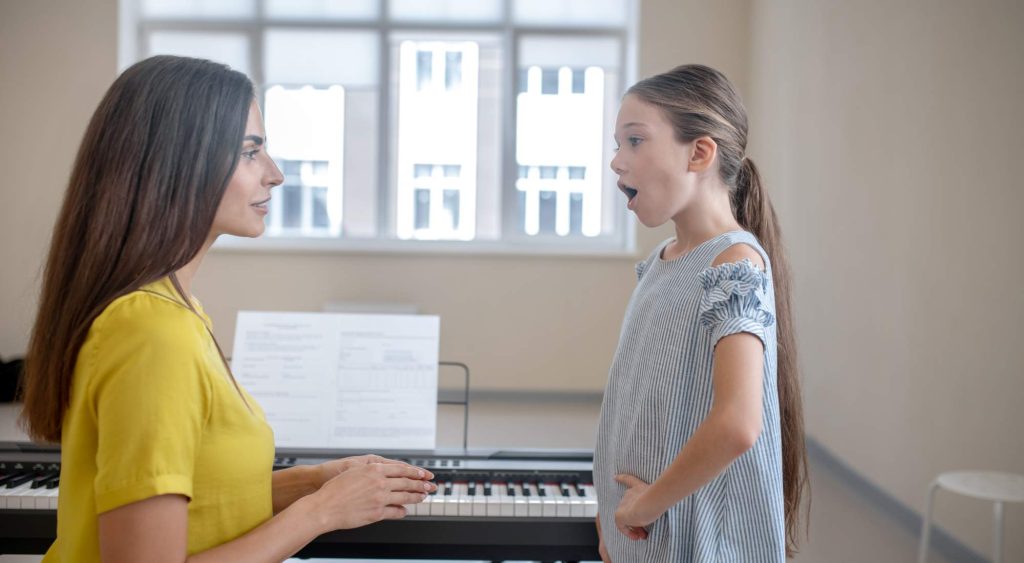
You may think voice lessons mean merely learning lots of songs with a fun instructor. Though students will definitely learn songs — hopefully with a fun instructor — voice lessons involve so much more than that.
To find out what lessons with Northwest School of Music look like, contact us today. We’ll tell you about our programs, introduce our team, and help you choose the right instructor and schedule for you and your child. As a bonus, when you register, you’ll get your first lesson free.
Vocal Technique Instruction
A skilled instructor will prioritize correct vocal technique with all their students, no matter their age.
Technical vocal instruction will include the following:
- Effective breathing
- Articulation
- Instruction on how the voice works to produce singing
- Posture
- And more
Choose an instructor who is committed to helping your child learn how to sing correctly and safely. An experienced and knowledgeable instructor will understand the young voice and vocal mechanism and choose appropriate relaxed exercises and singing techniques suited for young students.
Reading Music
To sing well, learning to read music is highly encouraged. Reading music has so many benefits for any musician no matter what instrument they play.
For young vocal students, reading music and learning basic music theory may include learning:
- Note names and tones (maybe using solfege – think “Do-Re-Mi” and The Sound of Music)
- Note values
- Time signatures
- Key signatures
- And more
Performance Opportunities
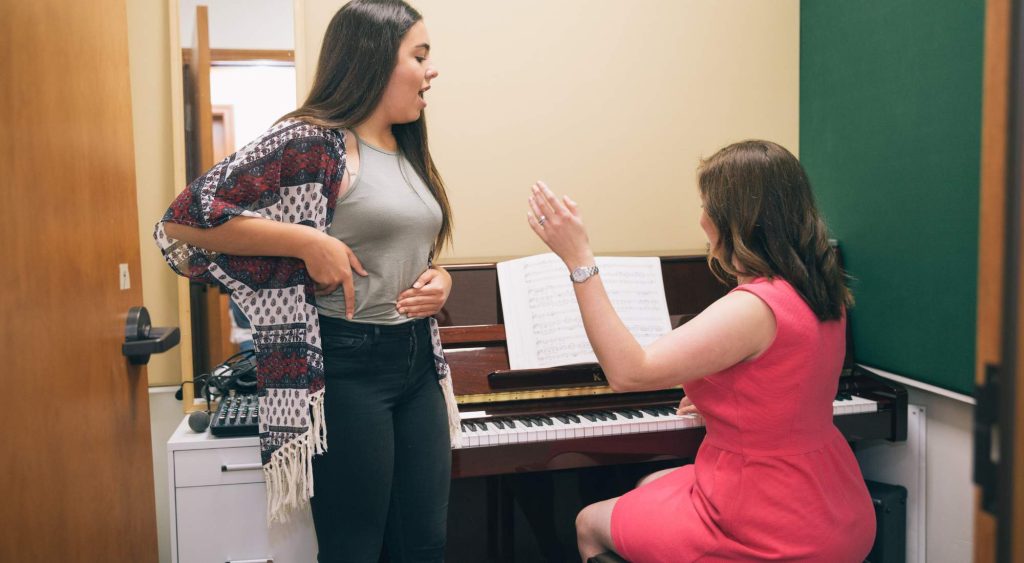
Most singers long for opportunities to perform — even if they get nervous — whether it’s for a family gathering in the living room or on stage at a concert.
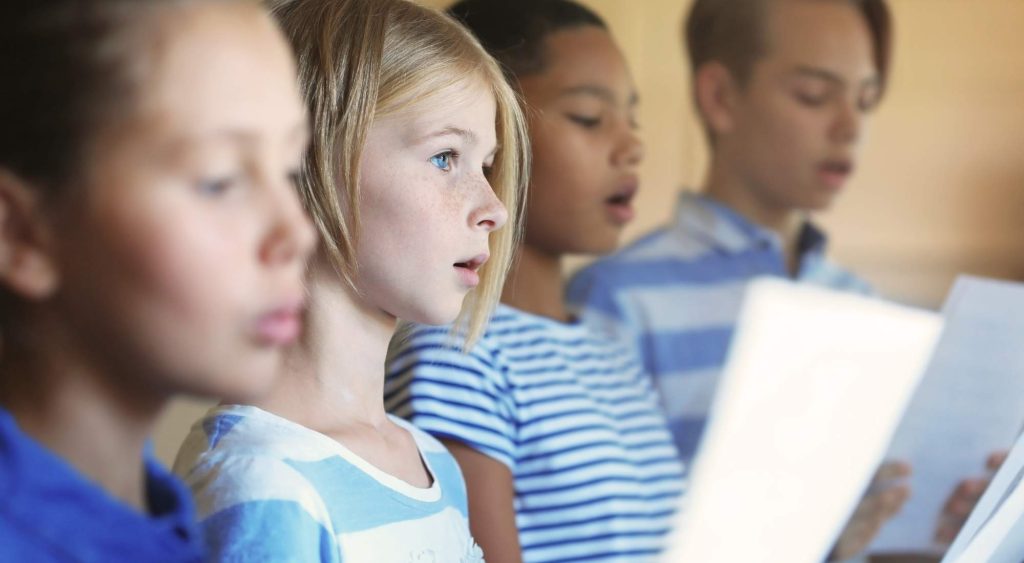
Most vocal instructors offer opportunities to perform in recitals and concerts. In addition to individual voice lessons, children enjoy singing with friends in choirs and ensembles, offering another opportunity to show off their skills as they sing with others.
In addition to providing opportunities to perform, vocal instructors will help students prepare by:
- Helping them memorize songs
- Teaching them proper standing posture
- Instructing them on bowing
- Teaching them how to project
- And more
New Songs and Genres
What does your child love to sing? Disney movie tunes? Songs from the radio?
Whatever your child is drawn to, voice lessons will give them the opportunity to sing more of what they love. They’ll also get the chance to learn new genres, and maybe they’ll fall in love with some of those as well — even the ones they didn’t think they’d enjoy.
Hard Work
Learning anything new takes determination and effort. Students will work hard during their lessons, and they’ll carry that hard work over into their practice sessions at home. Experienced voice instructors will be able to guide students and give them instructions on how to most effectively practice at home so they can reap all the benefits possible from their efforts.
Hard work pays off! Students who are disciplined and stick with it will experience a big payback.
Are Voice Lessons Good for Kids?
Yes! Voice lessons are good for kids for lots of reasons. Benefits of voice lessons for children include:
- Building confidence
- Making friends
- Developing musical skills
- And more
Let’s look at some more specific reasons why voice lessons for children can be profitable.
5 Benefits of Voice Lessons for Children
#1: Acquiring Vocal Skills
This should seem obvious. Of course, students will learn proper vocal skills when they take voice lessons. Some of the things they will learn include:
- Breathe control
- Posture
- Pronunciation
- Tone production
- Increased vocal range
- Articulation
- Singing safely
- And more
Not only will students learn to sing well when they take lessons, but singing may lower levels of stress and anxiety. When children sing, the vagus nerve is stimulated and increases the production of oxytocin. This hormone, often referred to as the “love hormone,” is related to feelings of relaxation, trust, and belonging. Therefore, singing is an optimal activity for children who may struggle with nervousness, loneliness, or connection with others.
#2: Growth in Confidence
Singing helps build self-esteem and triggers the release of endorphins, giving singers a natural boost of energy and confidence. Singing is one of the most powerful ways to practice stepping forward and growing in something that might initially be uncomfortable. In voice lessons, we’re not just working on sounding good; we’re learning to express ourselves with clarity, confidence, and heart.
#3: Improved Communication
Vocal coaching goes beyond simply learning how to sing — it also focuses on key elements like articulation, diction, intonation, and tone to support proper vocal technique. Along the way, children begin to recognize patterns in language and vocabulary, which strengthens their reading, public speaking, and overall communication skills. They also become more attuned to body language and facial expressions, learning how to adjust their speech and presence to connect more effectively with others.
#4: Engagement
Voice lessons and singing can be powerful tools for connection. Singing fosters social bonding and a sense of unity, making it a deeply personal experience that can strengthen relationships.
Studies have shown that group singing — regardless of skill level or age — acts as a natural icebreaker and can even synchronize the heartbeats of those singing together.
Singing in a group cultivates community among children, promoting empathy and a shared identity.
#5: Promotion of Body Awareness
Singing is more than just making music with your mouth. The whole body is involved with stance, posture, breathing, and more.
A skilled vocal instructor guides students in developing proper breathing techniques and physical alignment essential for performance. This physical engagement is deeply kinesthetic, connecting the body and mind.
The posture and breath work involved in singing also support psychological and neurological well-being, helping to reduce stress, foster joy and connection, and trigger the release of “feel-good” hormones that boost energy, mood, and self-confidence.
Start Your Child’s Singing Journey With the Skilled and Experienced Instructors at Northwest School of Music
Are you ready to get started so your child can take advantage of all these amazing benefits? Contact us today to begin your child’s voice lessons at Northwest School of Music.
Our team of experienced and seasoned instructors are committed to making music learning fun and safe. In addition to individual voice lessons, we also offer choir lessons to give your child the opportunity to make music with others.
Our lessons are offered month to month — no contracts to sign. Our schedule is flexible as well, so we can schedule lessons when it suits you and your needs.
Why wait? Register today to start your child’s musical journey — and get the first lesson free!
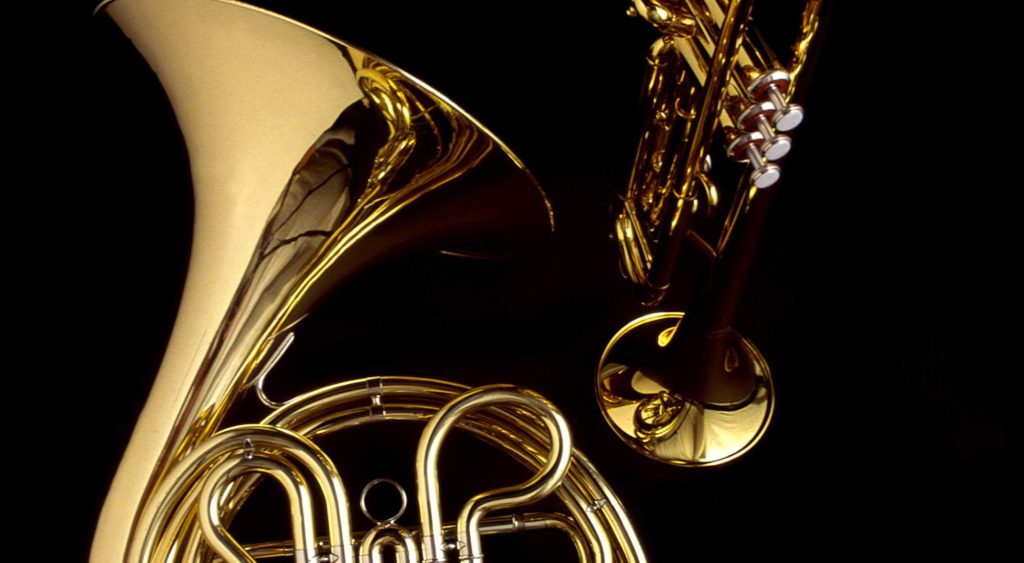
Should I Play the Trumpet or French Horn? A Look at the Pros and Cons
Trumpet Pros and Cons
There are both positives and negatives for learning the trumpet.
Pros:
- Easier to learn: Trumpets are known as good beginning instruments to learn.
- Widely available: Trumpets are easy to find to purchase or rent.
- Good for solo playing and band settings: Nearly all compositions can utilize a trumpet, making performance opportunities widely available.
- Wide range of music genres: Trumpets provide more options for the style of music.
Cons:
- More difficult to get scholarship money: There are more trumpet players than French horn players, making achieving a scholarship harder due to the number of applicants. Additionally, trumpets are viewed as easier to play, so musicians may not be seen as having as much talent or dedication as musicians of more difficult instruments.
- Higher notes are harder to learn: Higher notes require a tighter embouchure and are closer together, making them more difficult to play.
- Physical challenges: Musicians with braces or physical limitations may find getting proper embouchure harder.
French Horn Pros and Cons
French horns also have positive and negative aspects.
Pros:
- Richer tone and wider range: French horns create beautiful, expressive sounds and produce a wider range of notes.
- More rewarding roles in orchestras and ensembles: The French horn’s design allows it to make the music feel more complete.
- Less competition: There are fewer French horn musicians, so spots in ensembles and competition for scholarships are significantly less. This could lead to more scholarship money and performance opportunities.
Cons:
Physical demands: Proper posture and breathing techniques are required for quality sound and can be difficult for musicians to maintain.
Harder to learn: Embouchure is unique and more challenging because the wider range makes learning all of the note combinations more difficult.
Requires dedicated practice: The French horn requires the musician to make minimal changes to produce different notes and tones, requiring more practice time.
Less versatile: The French horn is versatile in its range of notes, but it’s mainly used in orchestras and classical music.
More expensive: The French horn is a complex instrument that requires more skill and time to manufacture, increasing cost.
Consider These Tips When Choosing To Play the French Horn or Trumpet
Try Both
Nobody says you have to choose ONLY one. Try them both out over a short period to decide which one you like the best.
Each instrument is a different musical experience. If you like the first instrument you try, you may like the second one even better. You don’t want to get locked into one instrument without exploring other options.
Once you become proficient, you can enjoy the benefits of learning a second instrument, including expanding your creativity, musical repertoire, and versatility.
Consider Your Musical Style Preferences and Goals
When picking an instrument, consider the type of music you want and the opportunities you desire.
Do you like jazz? The trumpet would be a great choice. Would you prefer to perform in an orchestra or band? Either instrument could work. Do you want solo opportunities? The trumpet may give you more. Are you working toward a scholarship? French horn may be the way to go.
Once you have the answers to these questions, your decision will be easier.
Evaluate Available Playing Opportunities
Learning to play an instrument on your own is one thing, but being able to play with others enhances the experience. Are there opportunities to play with groups near you? High school band/orchestra? Community opportunities? Church? Etc.
If you do have opportunities to play with others, consider which instrument would be needed in these groups. Are they missing a French horn player? Do they already have three trumpet players? These factors may help you decide.
Be Prepared To Practice
No matter which instrument you choose, it’s going to require devotion to practice. You can’t become good at something without allocating time to it.
While musicians are unique and have their own goals, it is standard practice to dedicate at least 20-30 minutes a day to practice and increase to 30-60-minute sessions as you gain proficiency.
Practice builds stamina and quality, creating a solid foundation to learn more complex techniques.
Lessons with trained professionals typically include a 10-15 minute warm-up to practice tones, scales, and mouthpiece buzzing. This is followed by foundational exercises to practice scales in different keys, fingerings, and range and breathing exercises. Finally, you will practice songs and performance skills followed by a cool down.
It is recommended that beginning musicians take lessons weekly. If you will be performing, you can also anticipate rehearsals before performances.
Research Instruction Opportunities in Your Area
The best way to learn an instrument is with a qualified, experienced instructor. You might want to play the French horn, but if there aren’t any instructors in your area, that might be challenging.
When searching for an instructor, look for these qualities:
- Strong educational background in music
- Experience teaching students of all levels
- Ability to inspire and nurture musical growth
- Teaching style that aligns with your learning style
- Patience, enthusiasm, and a positive attitude
You want an instructor who makes lessons engaging and who can help you grow as a musician.
Choose Northwest School of Music No Matter Which Instrument You Choose: Our Team of Instructors Is Ready To Help You Get Started
Whether you are looking for private lessons, group lessons, or lessons for littles, at Northwest School of Music, our instructors have the passion, the education, and the experience you need to begin or continue developing your music skills.
No matter what instrument you choose, we offer a wide variety of programs to help you reach your musical goals. We want to help you make your music dreams a reality.