


Do you love to sing but lament your lack of skill? Or maybe you’re like many people who think singing talent is congenital, and you just weren’t born with it. Too bad. You’ll just leave singing to the professionals and celebrities.
No way! Vocal ability is something that can be learned and practiced. Voice lessons can be just what you need to turn mediocre or even cringe-worthy singing into melodic and powerful strains.
Northwest School of Music explains how voice lessons can help you improve your singing voice. Read on to learn how to become a better singer regardless of your current skill level.
Table of Contents
- Do Voice Lessons Work?
- How Do Voice Lessons Work To Make You a Better Singer?
- Are Voice Lessons Useful?
- 7 Benefits of Voice Lessons
- What To Look for in a Voice Lesson Instructor
- Northwest School of Music: Where You’ll Find Voice Lessons That Work To Help You Meet Your Goals and Excel in Singing
Do Voice Lessons Work?
Yes, voice lessons actually work! But ultimately it depends on your goal. Do you want voice lessons to make you a better singer, prepare you to perform in public, or make you competitive enough to win singing contests?
You might have a different goal. Regardless of where you want your voice to take you, voice lessons can be of inestimable value. Contact Northwest School of Music to schedule a free voice lesson so you can see firsthand what you have to gain by committing to a teacher’s coaching and instruction.
How Do Voice Lessons Work To Make You a Better Singer?
Learning to play any instrument requires understanding the physics involved and practicing to accustom your body to produce the appropriate sounds. It is the same for learning to sing, but the instrument (your vocal chords) is inside you. Because of this, it is much harder to see how the instrument functions. A voice coach can help you understand the mechanisms at work so you can optimize the sounds you produce.

Integrating Vocal Registers
Voice lessons can help a singer navigate the different registers — chest, middle, and head — without abruptness or awkwardness. The smooth transition between registers is essential before you can develop greater power and resonance in your voice.
The “blending of the registers” does not often come naturally, which is why having an instructor is so helpful. Rather, it is common for singers to be well-developed in one of the registers, while the others are weaker and the connection between them faulty. Voice lessons can help them overcome this barrier to singing more pleasantly a wider range of notes.
Learning Breathing Methods for Singing
Breathing is natural and involuntary. We don’t even have to think about it. But singing demands a more thoughtful and practiced approach. There are different ways to learn to breathe for support, control, intonation, etc.
Support is important for keeping the voice steady and involves controlling how much air is expelled. When we sing, we must inhale more quickly and exhale more slowly than is natural, all the while avoiding mistakes that result in unproductive sounds.
Appoggio is an effective breathing technique that requires continuing to use the inspiratory muscles even while exhaling to avoid rapid loss of air and unsteadiness in volume and tone.
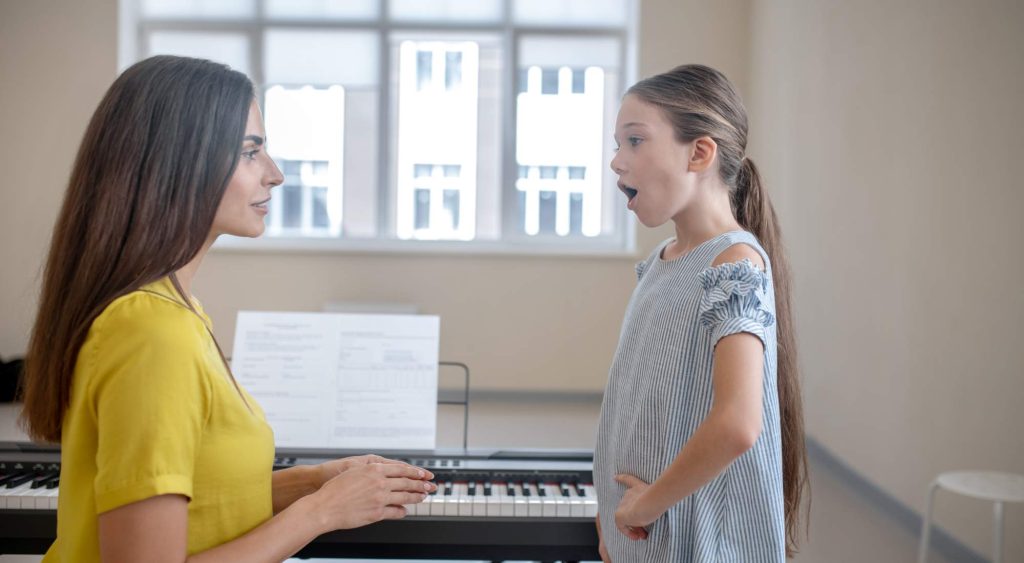
A voice coach can teach you how to perform this technique, including proper posture and supportive exercises to increase your capacity to do it.
Expanding Your Range
Your range is the distance between the highest and lowest notes you can competently sing. Professional singers — despite their natural designation (soprano, alto, tenor, or bass) — set themselves apart by being able to sing in a wide range. Voice lessons can help expand your vocal range, allowing you to sing all types of music.
To improve vocal range, you need to perform exercises that will stretch your vocal cords gradually, so that they maintain strength and resistance. Without resistance, you will slip into a falsetto on high notes.
Building Vocal Agility
Vocal agility refers to being able to move from note to note quickly and easily. When singing certain genres (like classical or opera), this is a necessary skill, learned most helpfully under competent tutelage.
A voice coach can guide you through the ways to build your vocal agility, including singing techniques and exercises that train the sound-producing muscles and gradually improve pitch accuracy.
Projecting and Singing With Power
This is another skill that must be learned, particularly if you are a classical singer or singing in the theater, so that you’re not just “belting” or “screaming” as you sing. Voice lessons can help you learn proper technique to be able to sing powerfully without your tone or vocal health suffering.
Establishing a Strong Posture
Posture involves more than just sitting up straight. Ideally, all parts of the body should be situated to maximize the cooperation of the lungs and vocal chords in steady, correctly-pitched sound production.
A few elements of proper posture are:
- An elevated sternum and expansion of the lower ribs: These are necessary to achieve appoggio.
- Strong abdominal and muscles: While these do not automatically make for good singing, they make learning to control muscles for singing easier.
- A lack of tension (i.e. flexibility)
These subtle adjustments may be difficult to detect for the untrained singer. A coach can perceive habits of faulty posture and teach you to counteract them.
Developing an Expansive Repertoire
Voice lessons can open up a world of music to sing and genres to enjoy. Each genre requires specific techniques that you can learn to master by working with a talented teacher who understands how to achieve the proper sounds required for classical, jazz, pop, rock, gospel, theater, etc.
Are Voice Lessons Useful?
Voice lessons are indeed useful in that they present the possibility of improvement in so many areas. When these improved facets of your voice and presentation are combined, the overall picture is drastically enhanced, making the difference between a pitiable amateur and an admirable musician.
7 Benefits of Voice Lessons
#1: Learning Correct Singing Techniques
Without voice lessons, you are at the mercy of a plethora of wrong techniques and bad habits that you’re not even aware of. Voice lessons can help you to dispense with these and sing correctly.
#2: Singing Safely and Staying Healthy
Singers can help maximize their vocal health by staying healthy and singing in a way that protects their voice from injury and overuse. Some of the following tips are self-explanatory, but others might surprise you:
- Avoid smoking, excess alcohol, and illicit drugs of any kind.
- Stay well-hydrated with water and water-rich foods.
- Drink water instead of clearing your throat, which can cause the vocal cords to become irritated and inflamed.
- Rest your voice if you notice it is hoarse or scratchy or if you have had a long day of singing. In addition, whispering and yelling are both detrimental to your vocal cords.
- Get plenty of sleep to ensure that your voice doesn’t suffer in terms of tone quality, volume, and clarity.
- When your throat is ailing, use natural products for relief.
- Breathe through your nose.
- Perform vocal warm-up exercises before singing.
#3: Improving Pitch/Tone
A voice instructor can help you develop clear tone and intonation. This can be achieved by:
- Relaxing the chin, throat, and soft palette
- Inhaling deeply while expanding the diaphragm
- Breathing strategically to create a beautiful sound
These habits are not self-explanatory or natural to the singer attempting to reach challenging notes. With your coach’s guidance, you can learn how you can most easily and effectively produce the pitches within your range.
#4: Getting More Singing Opportunities
Especially for singers who want to perform or win auditions, voice lessons can help give singers an edge on the competition, resulting in more singing/performing opportunities.
#5: Growing in Music Knowledge
Instructors can integrate music knowledge and theory into their lessons. These insights help us learn faster, understand the shape of the composition better, and thus sing as befits its thematic and harmonic structure.
In addition to improving your ability to blend your voice with a particular musical piece, a deeper acquaintance with music theory can help you appreciate what makes each piece unique. This appreciation will make reading and singing music even more enjoyable.
#6: Excelling in Ear Training
A singer needs a good ear to achieve the following in vocal preparation and performance:
Blending: This involves adjusting your volume, pitch, and vowel sounds to create a unified sound with other singers.choice. Just remember, you need an instructor good enough to make the cost and effort worthwhile.
Interval identification: Being able to discern the difference in pitch between two sounds is useful for sight reading and musical composition.
Harmony: This enriching sound is achieved by singing notes that are different from, but which complement, the main melody.

#7: Growing in Confidence
Unless your goal is simply to become a better singer in the shower, you will need a steady dose of confidence to perform. Whoever your audience is, you need confidence to sing in front of them. You need the assurance that you’re not humiliating yourself and wasting their time.
When you are coached well, receive regular feedback, and perceive your own progress toward your vocal goals, you will grow more confident that your voice is worth listening to.
What To Look for in a Voice Lesson Instructor
In order to competently bring a budding singer to new levels of performance, a good voice instructor should be:
- Knowledgeable: A respectable voice instructor has thorough knowledge of music theory, voice physiology, and musical genres with their associated techniques, at the very least.
- Experienced: Your voice instructor should be accustomed to the challenges that aspiring singers face and thus better able to coach you in overcoming them.
- Skilled: You need your voice instructor to have the ability to demonstrate the skills he/she is trying to teach you and to be discerning enough to detect faults in your practice.
- Easy to get along with: You want to feel comfortable around your voice instructor. If not, nervousness or irritation might make it difficult for you to relax and thus interfere with your progress.
Northwest School of Music: Where You’ll Find Voice Lessons That Work To Help You Meet Your Goals and Excel in Singing
For voice lessons in Salem, OR, contact Northwest School of Music. We guarantee you an instructor with all of the qualities described above. All our instructors have multiple years of experience and have earned a degree in music education and/or instrumental performance. We are dedicated to helping our clients become the best musicians they can be.
Besides voice lessons, we offer singing, choir, and instrumental lessons. You can learn in the setting of your choice: group, individual, or virtual. Contact us today for more information about our school and to schedule lessons to improve your vocal skills and become a more talented vocalist.



