


Are your facial muscles fatigued during and after playing trumpet? Are you struggling to reach high notes? Is the sound coming out of your trumpet less robust than you hoped? If so, you might be experiencing the results of poor trumpet embouchure.
It might be surprising, but you can solve all these problems just by improving the way your mouth contacts your trumpet’s mouthpiece. Who doesn’t want better sound, a wider range, and more musical endurance?
The Northwest School of Music explains here how to develop a more professional trumpet embouchure to get the most out of your practice and performance time.
Table of Contents
- What Is a Trumpet Embouchure
- 7 Steps To Form a Correct Trumpet Embouchure
- Tips for Developing a Strong Trumpet Embouchure
- Signs Your Trumpet Embouchure Needs Professional Guidance
- Perfect Your Trumpet Embouchure With Music Lessons From Northwest School of Music
What Is a Trumpet Embouchure?
The root of embouchure is “bouche,” meaning “mouth” in French. Essentially, it is the contact the mouth makes with the trumpet to produce and modify the sound of the instrument. The position of the teeth, jaw, lips, tongue, and facial muscles all play a role in controlling the speed and force of air entering the trumpet.
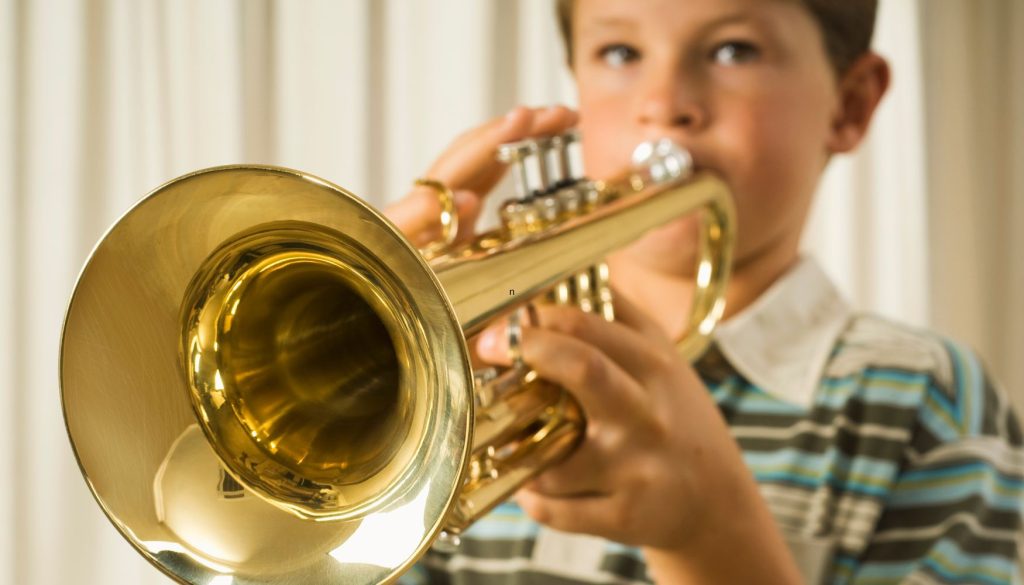
Why Trumpet Embouchure Matters
Many beginning musicians are tempted to do whatever it takes to produce certain sounds on the trumpet; for example, stretching the lips into a smile can help you reach higher notes. This instinctive measure is unsustainable and leaves much to be desired, however. It causes the facial muscles to fatigue quickly and creates a thinner sound.
Correct trumpet embouchure, on the other hand, allows a musician to reach a broader range of pitches without fatigue (or even injury) from too much muscle strain. To achieve this, you must learn control of the instrument by managing the variables that are directly involved in producing sound:
- Lip vibrations: The lips work like a reed, turning a stream of air (the breath) into pulses that cause the trumpet’s metal tubing to vibrate and produce sound. Faster vibrations produce higher pitches.
- Air speed: Sufficient air speed is required to produce a steady, resonant sound. It can be regulated, not by blowing harder or more softly, but by changing the size of the aperture.
- Size of the aperture: The size of the opening between the musician’s lips directly affects the speed, resistance, and frequency of the air flowing out. A larger aperture produces lower notes, whereas a smaller aperture can achieve higher notes.
What Makes a “Good” Embouchure
An effective, sustainable trumpet embouchure has the following characteristics:
- Firm (not “smiling”) mouth corners
- Flat chin
- Lips relaxed in the center
- Teeth slightly apart
- Lips resting inside the mouthpiece
If you’ve already developed a poor trumpet embouchure, the habit can be hard to break, but you can retrain your muscles to have this posture. It pays off by giving you greater flexibility without sacrificing your ability to create tension. In addition, you’ll notice your tone is fuller and more consistent because it allows freer airflow.
Musician coaches at the Northwest School of Music understand how adjustments in the embouchure influence a musician’s ability to play the trumpet well. Call today to set up your first lesson and begin mastering the correct embouchure for trumpet.

7 Steps To Form a Correct Trumpet Embouchure
Whether you’re working to correct a poor embouchure or learning proper embouchure for the first time, it helps to focus on one change at a time. These subtle movements are not always perceptible to an untrained observer, but once you start experimenting with their effect on your musicality, you’ll see the value of working toward each element of correct trumpet embouchure.
#1: Form the Lips
The lips should be in a natural resting position, as when you say “em.” This, as opposed to the “o” formation, gives the lips firm corners and a relaxed center. It is all that is needed to control airflow and to activate the appropriate muscles.
None of the red part of the lips should rest above or below the mouthpiece. If necessary, curl your lips inward toward your teeth to expose less of the lips and find the right amount needed to form the correct embouchure.
#2: Firm the Corners
Keep the corners of the mouth firm and the center relaxed. Do not allow them to stretch into a smile. This will allow you to have better control of the aperture size and thus airflow. Moreover, firm corners allow you to create a more effective seal against the mouthpiece and thus prevent the leakage of air, which weakens the instrument’s sound.
#3: Flatten the Chin
Don’t bunch or wrinkle your chin. Keeping it flat will help ensure proper muscle support for the lower lip, which is largely stabilizing the top lip as they buzz together. In addition, a flat chin supports the proper position of the corners of the mouth.
#4: Position Teeth To Maintain Proper Airflow
The teeth should be slightly apart, forming a rather relaxed opening, to allow for maximum air volume and free vibration of the lips. The opening should be large enough to allow the tongue ample room to move and to prevent any airflow restriction by the teeth.
#5: Position the Mouthpiece
The mouthpiece should be at the horizontal and vertical center of the lips. None of the fleshy part of the lips should be visible outside the mouthpiece. This alignment allows balanced lip vibration and tone quality, as well as equal engagement of muscles around the lips, which helps prevent strain and fatigue.
#6: Check Muscle Tension
It’s important to strike a balance between the right amount of tension of the appropriate muscles and relaxation of the rest of the body. People tend to err on the side of too much tension. Some tension is required, particularly in the corners of the mouth (to maintain the proper embouchure) and the abdominal muscles (to force out air), but the body should be otherwise relaxed. Strain in the chin, throat, neck, and shoulders is not appropriate tension.
#7: Create the Seal
Your lips should touch the mouthpiece slightly to create a cushion, but they should not be tight enough to hinder vibration. Ensuring there is no space between the lips and teeth and moistening the lips are also essential for ensuring a tight seal.
An adequate seal is firm enough to stabilize the entire embouchure, but doesn’t put so much pressure as to be painful. You’ll have to experiment to find the perfect way to form the seal. While there are habits to definitely avoid, variations in facial and mouth structure make it difficult to describe in detail the fine-tuning you’ll need to create a proper seal.

Tips for Developing a Strong Trumpet Embouchure
While individual variations do determine precisely how musicians fine-tune their embouchure, there are some indispensable principles that everyone should follow, beginning with those outlined in the seven steps above. While you seek to improve those elements, consider the following tips to assist your progress:
- Practice routinely: Don’t expect to perfect your trumpet embouchure quickly. Bad habits take a long time and deliberate effort to unlearn, and good habits may not become second nature until you have practiced extensively, day after day, month after month. Shorter, consistent practice sessions will accomplish more for you than long, tiring sessions that you can only manage infrequently.
- Strengthen facial muscles: By doing endurance drills and playing etudes regularly, you can strengthen the muscles utilized in an effective trumpet embouchure. But play wisely, giving your muscles a chance to rest to avoid overtraining that leads to injury.
- Develop flexibility: Lip flexibility is essential to controlling tone across a wider range and avoiding fatigue. The ability to move fluidly from one tone to another and to keep the tones even are not possible without flexibility. Practicing lip slurs is the basis of developing flexibility. Lip slurs are exercises that involve going from one note to another by focusing only on air speed and direction and the shape of the oral cavity.
- Use a mirror as a visual check: You may also benefit from using a visualizer tool, which is like a mouthpiece with only the rim, which allows you to see the position of your lips as you practice forming proper embouchure.
Stop yourself if you notice that you’re committing these common mistakes:
- Puffing cheeks: This makes it difficult to control your embouchure and air flow.
- Excessive pressure on the mouthpiece: This interferes with sound production as you need to keep your lips flexible. It’s also painful!
- Too much jaw motion: This ends up destabilizing the lower lip and giving you problems controlling air flow and maintaining a seal on the mouthpiece.
- Neck or shoulder tension: Keeping these muscles tensed probably indicates that the right muscles are not working as they should. It also leads to fatigue.
- Shallow breathing: The flow of air is the source of sound produced using the trumpet. Without deep breaths, you can’t provide the steady column of air required for lip vibrations.
- Smiling: A smile may help you reach higher notes, but it also stretches the lips too taut for effective vibration, leading to a thin sound and less control over air speed and direction.
Signs Your Trumpet Embouchure Needs Professional Guidance
Considering how much effort it takes to play the trumpet well, you don’t want all your work to take you in the wrong direction. You might be unwittingly forming habits that are detrimental to your trumpet playing, level of satisfaction, and oral health. The following signs indicate that you would reap substantial benefit from consulting a professional coach:
- Physical discomfort from excessive pressure on the mouthpiece
- Uncontrolled or unstable sound
- Range limitations
- Poor endurance
- Inconsistent placement on the mouthpiece
- Visual tension in the wrong places
- Poor intonation

Perfect Your Trumpet Embouchure With Music Lessons From Northwest School of Music
Let the instructors at Northwest School of Music coach you through to a more sustainable and effective trumpet embouchure. Among the many reasons you should consider our music school are:
- Our scheduling and lesson format flexibility
- Our diversity of instruments
- Twenty years of experience coaching people of all ages
- Our excellent instructors, most holding a degree in either music education, music performance, or both
We have an array of programs available both online and in person, serving multiple age groups. Or you may choose to receive private lessons. Call us today to learn more about our offerings and how we can help you achieve your musical aspirations!



