


The Ohio State University Marching Band may be the best collegiate marching band in the U.S. In fact, they’ve been dubbed “The Best Damn Band in the Land” — and rightly so. They give the fans a spectacular show with their fancy moves, marching innovations, and high-spirited formations. And they make it look so easy!
Sure, they’ve had lots of practice, but how hard is marching band?
Marching band may be challenging, but that doesn’t mean it’s not worth pursuing. In this article, we’ll take a look at what marching band involves, strategies you can employ, and how working with an instructor at Northwest School of Music can help get you started on your marching band journey.
Table of Contents
- How Hard Is Marching Band
- 6 Strategies for Marching Band Success
- How To Move in a Marching Band
- Is High School Marching Band Worth It?
- Northwest School of Music Can Help You Perfect the Instrumental Skills Required for Marching Band

How Hard Is Marching Band?
A marching band is a group of people playing instruments while on the move, whether in parades, sporting events, or high school or college competitions.
Of course, everything is relative, but we think marching band can be hard — a challenging kind of hard — and here’s why.
You have to do a lot of stuff at the same time!
Playing your instrument is just one part of participating in the marching band. Along with playing, you’ll also be required to:
- Move your feet (marching) according to a specific method
- Play memorized music
- Move in a particular formation with the other band members
- Consistently arrive at a specified spot with each movement
- Breathe properly
- Carry your instrument correctly
- And more
Marching Band Requires Multiple Skills
On the surface, being in a marching band looks fairly simple. Just play some music and walk around while you do it. But observing and doing are two different things.
If you participate in a marching band, you’ll find that it involves many skills, all employed at the same time. You’ll need to simultaneously, exercise:
- Musical skills
- Physical skills; and
- Mental skills
Most obviously, you need to learn how to play an instrument, and you’ll need to know the basics of music theory. Learning with a private instructor or as part of a school program are great ways to get started.
Though it may not look physically daunting, marching in a band requires physical strength and stamina. You’ll need to learn proper marching techniques, endure hours and hours of practice, and then perform in shows that may require carrying and playing your instrument (and maybe a heavy one, like a tuba) for 10 minutes or more. Staying healthy and fit is important to keep you in top physical condition for the physically demanding parts of a marching band.
Not only is your body physically engaged, but your mind is super active in a marching band, and memorizing is key. You need to memorize the music and all your movements across the football field. Don’t forget about the rest of your band members — you’ll have to keep in step and in line with them the entire time. You’ll do all that while watching the director or drum major while playing with style and precision. It’s a lot for your mind to keep up with.
If you’re just getting started on your music journey with marching band in your sights, let the team of experienced music instructors at our music school in Salem, OR, help you get started. Northwest School of Music offers individual and group lessons for woodwind, brass, and percussion instruments. Register today and receive a free session.

6 Strategies for Marching Band Success
#1: Learn Your Instrument
Whether you’re a beginner to your instrument or have been playing for some time, you need to learn how to play your instrument expertly so you can focus on the other aspects of marching band (like walking or choreography).
Learning your instrument is more than just blowing into it and moving your fingers the right way. Breath control, embouchure, stylistic techniques, music theory knowledge, and more are essential to playing your instrument well.
A marching band is made up of more than wind instruments. Don’t forget about the indispensable percussion section — which includes a variety of instruments like:
- Snare drums/quad drum sets
- Bass drums
- Cymbals
- Xylophones
- And more
Often, percussion musicians learn how to play several instruments, making the learning process even more challenging.
Of course, learning to play your instrument well takes loads of practice — and lots of patience.
#2: Keep Studying
Once you’ve learned the basics of playing your instrument, being committed to regular and effective practice is the best way to progress. Whether it’s marching band season or not, keep playing and keep practicing to further hone your musical skills.
You’ve heard the saying, “Practice makes perfect.” At Northwest School of Music, we believe that “practice makes progress,” and we’re poised and ready to help you progress and reach your goals. Our team of highly skilled and seasoned instructors can help you maximize your practice time while helping you improve with each session.
#3: Maintain Good Health
Playing in a marching band is a physically demanding activity. Unlike concert band, where you have the luxury of sitting down to practice and perform, marching band involves nearly constant movement during the short performances and many hours of practice.
Maintain good physical health by practicing your strength and endurance in the following ways:
- Eat a healthy diet
- Get adequate and quality sleep
- Keep moving and get regular exercise by:
- Strength training
- Walking or running
- Playing a school sport
- Playing sports with friends
- Using steps instead of the elevator
- And more
#4: Warm Up Properly
No matter how motivated you are to jump on the field and start marching and playing, warming up your instrument and your body is important for good health and good performance.
Warming up your instrument can prevent injuries and make your practice time more efficient. A warm-up may include playing:
- Scales
- Arpeggios
- Musical drills
- Parts of performance pieces
To warm up your body for optimal practice and performance, add these activities to your warm-up routine:
- Stretches
- Fingers
- Wrists
- Hands
- Back
- Legs
- Joint movements
- Squats
- Arm circles
- Breathing exercises
- And more
Don’t forget to cool down to help reduce aches and pains and prepare the muscles for your performance.
#5: Acclimate to the Weather
Marching bands can perform and practice all year long. Often, schools hold band camps during the hottest parts of the summer. The fall and early winter may be taken up with football halftime shows and competitions, and parades can happen any time of year — like the Macy’s Thanksgiving Day Parade, Christmas parades, St. Patrick’s Day parades, and more.
With so many opportunities to practice and perform, marching band members need to be prepared to endure the elements, including:
- Hot and humid summer conditions
- Cold and windy fall weather
- Snow in the winter
- Rainy weather with varying temperatures
If you’ve played in a marching band before, you know that most band uniforms have a lot to be desired because they’re often bulky, heavy, and restrictive. Make sure you know how your band uniform works for you so you can alter it if needed by adding on extra layers, keeping a change of clothes on hand, or planning to stay extra hydrated in extremely hot and humid weather.
#6: Stay Hydrated
No matter the weather, adequate hydration is essential. Of course, hot summer temperatures can have a greater impact on hydration than cooler temps, but you can still become dehydrated in winter if you’re not drinking enough water.
Recommendations vary, but the Institute of Medicine of the National Academies of Sciences, Engineering, and Medicine suggests women drink 91 ounces of water per day and men drink 125 ounces of water daily. On extremely hot days, adding electrolytes to water or drinking electrolyte drinks is a healthy way to keep from becoming dehydrated.
Remember, it’s important to drink water and stay hydrated before, during, and after your practice or performance.
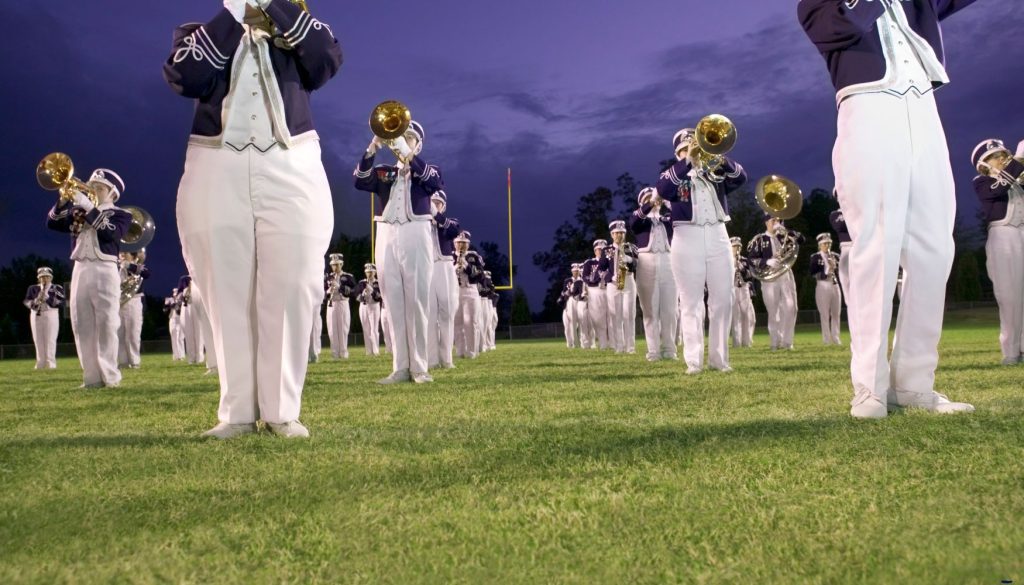
How To Move in a Marching Band
To the untrained eye, marching may look just like walking, but marching and walking are really quite different. Of course, marching involves walking at its core, but for precision and uniformity, marching band members need to learn the proper marching technique, which can be physically draining.
Basic Steps for Formation
Marching bands will usually follow these basic formation steps:
- Stand at attention per the director’s instructions. This may mean having your feet together at the heels with the foot pointed out at an angle.
- At the director’s command, bring your instrument up to the playing position with a sharp motion.
- Begin marching with the left foot so that it hits the ground on beat one.
- Follow the instructions according to the show, stopping, starting, and turning at the appropriate times.
- March with proper posture, keeping your eyes straight ahead and your head high. Face your body to the appropriate position and hold your instrument correctly.
- Keep in time with the music beats. Your feet should hit the ground on the downbeats.
Marching Forward
Follow these steps to march forward:
- Begin by planting your left heel on the ground first, with your toes raised.
- Roll the rest of your foot to the ground from the outside to the top of your foot.
- Repeat with the right foot and continue alternating.
- Keep your knees straight for this smooth type of marching. Some styles may require snappy movements when your knees come up with each step.
To see how the Ohio State Buckeyes do it, click here.
Marching Backward
Marching in a band requires marching in place, forwards, and backward. Here’s what to think about when you march backward:
- Start with your left foot and step so that your toes touch first, and move your right foot in the same way.
- Keep your heels from touching the ground until you come to a stop.
- As with marching forward, keep your knees straightened. If you’re making large steps, you may need to bend them slightly.

Is High School Marching Band Worth It?
Yes! We’d say participation in the high school marching band is totally worth it. Even with the challenges it may present, playing in the school marching band is an excellent way to be involved in school activities and show your school spirit, especially if you’re not involved in school sports.
Beyond that, playing in the school marching band can come with these additional benefits:
- Increased physical endurance
- Enhanced mental strength
- Teamwork
- Discipline and determination
- Creativity
- Building strong relationships
Northwest School of Music Can Help You Perfect the Instrumental Skills Required for Marching Band
Let Northwest School of Music help establish a strong musical foundation you can build on. If you’re interested in joining the school marching band or aren’t sure yet, our experienced music instructors can help guide you no matter what your goals are.
We offer group and individual lessons for both children and adults for the following marching band instruments:
- Drums
- Guitar
- Trombone
- Trumpet
- Baritone
- Tuba
- French Horn
- Saxophone
- Clarinet
- Flute
Getting started is easy. Simply register, and we’ll be in touch to discuss lesson details that will work with your schedule.



