


Ask any experienced band director, and they will confirm that posture can make or break a French horn player’s sound.
The difference between the characteristic rich, full tone and a strained, airy sound is often simple. It’s your posture when you are sitting or standing and how you hold your instrument.
Many beginning musicians focus on learning notes and proper fingertip placement, but neglecting posture can lead to poor tone, restricted airflow, and fatigue.
In this guide, you will learn how to hold your instrument with confidence, common mistakes to avoid, and strategies for developing good habits.
Table of Contents
- How To Hold a French Horn Step by Step
- Why Do French Horn Players Put Their Hands Inside?
- 3 Common Beginner Mistakes When Holding a French Horn
- 3 Tips for Building Good French Horn Habits Early
- How Proper Holding Technique Improves Your Playing Over Time
- Learn How To Hold a French Horn and Other Valuable Techniques at Northwest School of Music
How To Hold a French Horn Step by Step
Find the Correct Seated or Standing Posture
When playing the French horn seated or standing, the following factors are significant:
- Keep your back straight to avoid slouching.
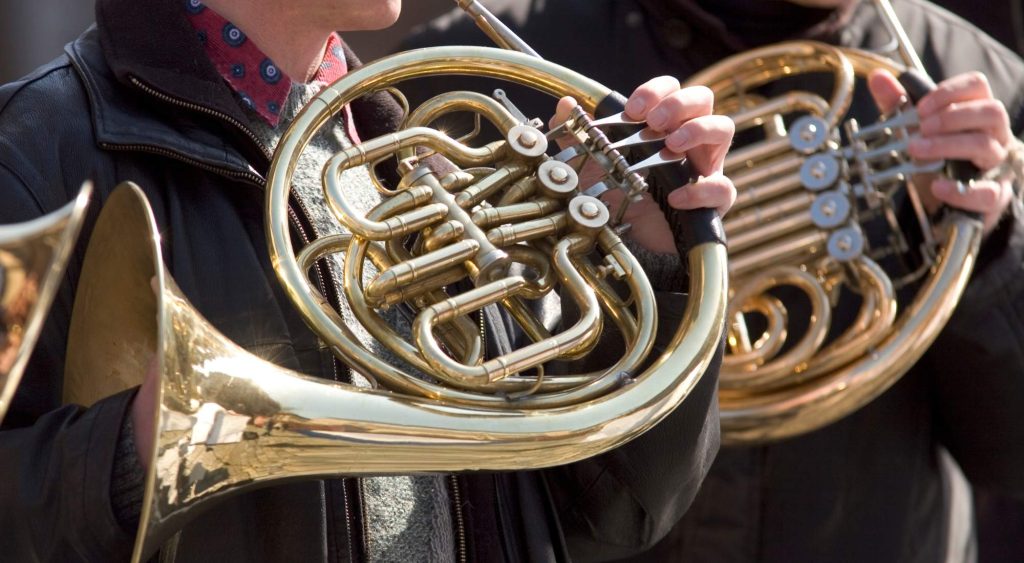
- The left fingers will be placed on the hook and valves.
- Your right hand will be placed inside the bell on the far side.
- Your mouth should reach the mouthpiece without straining.
- Your shoulders need to remain relaxed to make sure your torso is open for a full range of breath.
If you are seated, the best practice is to sit on the front half of your chair with your back straight. Your feet should be positioned flat on the floor, and your right leg needs to be slightly forward for the bell of the horn to rest lightly on.
When standing, keep your spine straight, and place your feet shoulder-width apart to maintain stability and balance. Your neck should be kept straight with your head resting in a natural position.
Position the Right Hand Inside the Bell
Inside the bell, your hand should be slightly cupped with the knuckles touching the inside of the bell closest to your body at a 3 o’clock position and perpendicular to the floor. Your hand should not block the air completely, but it should be far enough inside that there is a space roughly the size of a small orange.
Hand placement is important because it impacts the:
- Tone
- Intonation
- Resonance
- Support
Proper hand placement produces the warm tone, controls the pitch, and allows the sound to be reflected inside the bell while providing support for the instrument’s weight.
Support the Horn With Your Left Hand
The primary purpose of the left-hand position is to operate the valves, but it is also used to support the instrument.
Your index, middle, and ring fingers should be positioned on the three main valves in a relaxed “C” shape. The pinky should be placed on the hook, and the thumb should be on the thumb trigger or lever.
When supporting the weight of the instrument, it should fall mainly on your palm and knuckles, not your finger pads.
Your grip should be firm, but not tight. Tension prevents your fingers from being able to move naturally and with ease. Be careful to not overly bend your wrist and keep your elbow relaxed to prevent tension and fatigue while playing.
Align the Mouthpiece Properly
As you begin to play, the mouthpiece should be positioned at a slightly downward angle to align with your teeth, centered, and ⅔ of the mouthpiece should rest on your upper lip, with ⅓ on your lower lip. This placement allows your lips to vibrate freely and gives you proper embouchure.
If your mouthpiece is improperly placed, it may result in:
- Limited range
- Poor tone
- Forced sounds
- Lip fatigue
- Possible lip pain
- Missed notes
It is best to bring your French horn to your mouth instead of bending your head or neck to maintain proper posture.
Why Do French Horn Players Put Their Hands Inside?
Using the hand inside the French horn originates from the very first French horns that were valveless. In modern day, the hand is used to control the sounds produced by shaping the tone and pitch. Hand placement inside the bell also provides support for the instrument when the musician is playing.
Controlling Tone and Pitch
Methods used to control the sound of the French horn include:
- Moving the hand in or out: This adjusts the pitch of the notes.
- Opening the hand: This makes the notes sharper.
- Covering the bell more: This makes the notes flatter.
- Hand-stopping: This produces a nasal, brassy sound.
These techniques keep the French horn from sounding too brassy and bright. They also help fine-tune notes and can be used to create the special effects of a muted, buzzing sound.
Creating the Signature French Horn Sound
The French horn is known for its characteristic warm, mellow, dark timbre. Hand placement inside the bell softens the brassy sound so that it sounds velvety. Without the hand, it would sound more like a trumpet.
The hand also helps filter out higher sounds, making the notes darker and warmer. It is also used to help tune notes spontaneously as needed during songs.
3 Common Beginner Mistakes When Holding a French Horn
#1: Gripping Too Tightly or Too Loosely
Gripping the French horn too tightly while playing can lead to physical repercussions and negatively impact the sound, including:
- Hand and wrist pain
- Rapid fatigue
- Unstable finger positions
- Improper operation of the thumb valve
- Numbness
- Nerve issues
- Unnecessary tension on the shoulders, arms, and back
- Reduced speed
- Reduced flexibility
- Muted or inconsistent tone
- Inability to play for long periods due to muscle fatigue
Holding the French horn too loosely can also have physical implications and affect sound quality, including:
- Instability leading to tensing the shoulder, neck, or arm to brace the instrument
- A sound that is too bright and open
- Inconsistent pitch
- Rapid muscle fatigue
- Risk of dropping and damaging the horn
- Poor air control
- Inefficient tongue movement
Proper grip helps maintain a balance between control and relaxation. Musicians need both to effectively play the French horn.
#2: Incorrect Hand Position Inside the Bell
Blocking too much or too little changes the sound of the French horn.
When the hand blocks too much, the sound can become muffled, dull, or dark. The pitch is also flatter than it should be because the notes are harder to strike.
When the hand doesn’t block enough, the sound becomes brassy and thin. The brightness of the sound contrasts with the warm timbre it is meant to have. The pitch also tends to be higher, and the notes are harder to control.
Your hand size can impact its position inside the horn. If your hand is small, it is good practice to spread your hand to prevent leaking air. If your hand is large, be mindful not to block too much.
#3: Poor Posture While Playing
The biggest impact of poor posture while playing is that slouching restricts air flow, which prevents deep breathing. As a result, sustained notes are limited, and overall sound quality is impacted, making it sound choked or hollow.
Fast songs become difficult, and it becomes hard to maintain a consistent pitch due to the inconsistent angles of the mouthpiece.
Poor posture also creates tension in the body, which can lead to pain in the shoulders, neck, and back, as well as joint strain.
Tips for proper posture include:
- Keep your head, neck, and back aligned.
- Sit on the edge of the chair.
- Keep your spine straight.
- Raise the instrument to your lips.
- Relax your shoulders.
- Support the instrument with your right hand or leg.
3 Tips for Building Good French Horn Habits Early
#1: Practice in Front of a Mirror
Practicing in front of a mirror will benefit beginning musicians by:
- Giving immediate visual feedback
- Checking for proper mouthpiece placement
- Spotting slumping or improper posture
- Showing if hands are positioned properly
- Identifying unnecessary movements
The mirror will allow beginning musicians the opportunity to self-correct and begin to perfect their posture, hand positioning, and embouchure.

#2: Start Slow and Focus on Consistency
Learning to play the French horn can be difficult, so starting slow and working on consistency has many benefits, including:
- Learning proper embouchure
- Developing breath control
- Preventing bad habits
- Reducing muscular strain
- Learning the precise placement for each note
- Developing muscle memory
- Focusing on creating a consistent tone
- Staying relaxed
- Maintaining control over breathing and posture
Repetition helps build positive habits while learning the basic fundamental skills. Trying to be speedy or play complex songs before developing these skills and habits can be detrimental.
#3: Ask for Feedback From a Teacher or Mentor
Getting guidance from a professional is an effective way to develop good habits and establish proper techniques.
Teachers and mentors can give immediate feedback on:
- Poor embouchure
- Hand position
- Posture
- Air support
- Comfortable ways to hold the horn
Teachers and mentors can help students learn what the French horn should sound like. They can give positive, constructive feedback to motivate students and help them build a strong foundation from the beginning. Our highly-qualified music instructors at Northwest School of Music are ready to assist students of all ages and levels, including French horn students. With convenient class schedules and performance opportunities, you or your child can begin to build a solid foundation of musical skills.

How Proper Holding Technique Improves Your Playing Over Time
The more musicians practice and perfect their techniques, their posture becomes more evolved. Rather than being rigid in posture, their posture becomes more relaxed and efficient. This change in posture allows for more comfortable playing, better endurance, and improved sound quality.
As long-term improvements happen, musicians will experience:
- Enhanced sound quality by holding the horn entirely with their hands
- Increased left-hand stability
- Reduced hand fatigue
- Improved intonation and sound control with subtle right-hand adjustments
- Improved tonal quality and resonance
- Performance for extended periods without becoming fatigued
- Avoidance of muscular pain
- Better air support
- Consistent sound
Learn How To Hold a French Horn and Other Valuable Techniques at Northwest School of Music
Offering programs for all ages with small class sizes, Northwest School of Music has instructors who are trained and experienced in teaching students a variety of instruments. We have a proven track record of excellence since 2006, and we offer flexible, convenient options to work with everyone, including college students, retirees, and working professionals.
Whether you want to learn as part of a group or privately, 30 minutes a week or 60 minutes, already own an instrument or are looking to purchase one, we have options for you. Begin or advance your musical aspirations with Northwest School of Music.
Register today and attend a free learning experience before you begin your lessons!



