


Has your eagerness to become great at the guitar settled in the doldrums? You’ve made the initial effort to break ground, but you find the territory so vast that it’s unclear which path to take.
With guidance from well-traveled guitarists and a vision of a clear trajectory, nothing should stop you from charting real progress toward exceptional talent.
The Northwest School of Music describes several landmarks you will encounter on your way to becoming a truly advanced guitar player. We can even help you reach them as smoothly and with as little wasted energy as possible.
Table of Contents
- Moving From Intermediate to Advanced: 12 Tips To Take Your Guitar Skills to the Next Level
- How Long Does It Take To Become an Advanced Guitar Player?
- Improve Your Guitar Playing Skills With the Experienced Team at Northwest School of Music in Salem, Oregon
Moving From Intermediate to Advanced: 12 Tips To Take Your Guitar Skills to the Next Level
Whereas an intermediate guitar player understands and demonstrates proficiency on a basic level, the advanced guitarist:
- Has mastered the technique of playing complex pieces
- Understands the theory underlying music production
- Can competently improvise or create new sounds
These milestones might seem to be a great distance from where you are now, but Northwest School of Music can help you move gradually closer to your goal using the following tips.

#1: Fine-Tune Your Practice
Progress will only come through regular and consistent practice, but not all practice is equally valuable. Be sure you are practicing smart.
Set Goals for Your Practice Sessions
Have a specific and measurable goal for each practice session, whether it is only 15-20 minutes or an hour. For example, repeat a lick 200 times or learn to play a given song.

Rotate Technical Skills Practice
Make a list of the skills you want to acquire as an advanced guitarist. Each skill has various elements. For example, when you learn strumming, you must attend to:
- Continuously moving your hand
- Keeping a loose wrist
- Hitting three or four strings at each strum
- Holding your pick loosely
- Learning a particular strumming pattern
When you rotate skills in practice, you focus on one element at a time until you perfect it. Focus on the next element after the first has become ingrained. Keep doing this until you cover each element of the skill.
Other skills you may wish to master include:
- Synchronizing your hands
- Tension control
- String noise control
- Vibrato
- Legato
- Pick hand techniques
- Certain scale sequences
Another approach you can add to your rotation is to focus on one finger or note at a time, and move on to the next only after you achieve a flawless sound on the first. This approach may require you to play with exaggerated slowness, but the goal is to perfect the movement through repetition and gradually increase speed.
Practice With Directional Picking
Directional picking, as opposed to alternate picking, means your pick takes the shortest path possible to different strings. Mastering this technique will allow you to play faster and more efficiently.
You won’t pick each string from the same direction, as with alternate picking. Rather, the direction will depend on the string you are coming from and from what direction you picked it.
For example, if you are ascending in pitch, strike the second string with a downstroke. If you are descending in pitch, strike the second string with an upstroke. Doing this saves time and effort because your hand is already moving in that direction.
Mastering this technique can be tricky, especially if you are accustomed to alternate picking. The instructors at Northwest School of Music can help you organize your practice time and strategy so that you’ll get the hang of directional picking and thus play faster, more precisely, and more safely.
#2: Focus on Ear Training
A player with a well-trained ear has more freedom because he doesn’t have to be chained to sheet music or guitar tabs. If you can identify chords and melodies, it will be easier for you to recreate them when you play. You’ll also be able to improvise with a more sonorous result.
Strengthen your ear by:
- Listening to music from many genres and trying to identify chords and melodies, paying attention to the dynamics and how they affect the tune
- Playing what you hear on your guitar
- Singing your scales as well as playing them
#3: Play With Others
The best way to learn to speak a language is to be steeped in the culture. This is equally true of the language of music. Besides developing a better ear for rhythm and musicality, musicians in a group grow in their ability to synchronize their tempo and stay in harmony, as well as to communicate nonverbally.
Furthermore, the musician in a group has these advantages over a solo musician:
- Learning to adapt playing to harmonize with other elements of music
- Exposure to different approaches to music
- An encouraging support system and a sense of belonging
- Development of communication, teamwork, and leadership skills
- A more confident stage presence
#4: Learn Music Theory and Use It in Your Playing
Learning music theory starts with understanding scales, chords, and the proper relationship between notes. This knowledge helps you understand music’s structure so that you can identify, create, and eventually perform respectable music.
Training in advanced theoretical concepts like chord substitutions, modal theory, and sequencing will allow you to produce harmonic music and enrich it with creative flourishes that don’t clash with the dominant sound.
#5: Experience and Specialize in Different Genres
The guitar is a versatile instrument, made for many different types of music. Listening to the tremendous range of what your guitar is capable of may inspire you with renewed respect for the instrument.
There are other practical benefits of experimenting with different genres:
- Be exposed to techniques and chord progressions characteristic of each style.
- Grow in creativity and improve your composition.
- Become a more versatile musician.
While you should experience other genres for these reasons, it’s a good idea to specialize in one, at least initially, for a few reasons:
- It helps you develop and perfect your style.
- Potential clients can more easily find and book you.
- Your music is more stable, and your audience knows what to expect.
#6: Secure a Mentor or Instructor
Everyone benefits from being around those who are experienced in what we want to learn. Having a guitar mentor or instructor can help you:
- Learn the instrument faster than you would on your own.
- Correct bad techniques before they become habitual.
- Stay accountable to your stated goals.
- Grow in confidence.
- Secure networking opportunities.
The instructors at Northwest School of Music provide this and more for our students.
#7: Learn How To Book Gigs and Market Yourself
Performance in front of a crowd can be an instructive experience as well as a chance for your hard work to be recognized and enjoyed by others. Reaching the stage, however, isn’t easy. You’ll need to be able to network with the right people (i.e. potential clients) and learn to market your music.
Remember as you work to secure a gig that you need to demonstrate to your potential client that:
- You are trustworthy.
- You are comfortable to be around.
- You can make their business look good.
Demonstrate these things in your marketing, and you’ll be more likely than the next budding musician to be hired to play.
#8: Focus on Technique
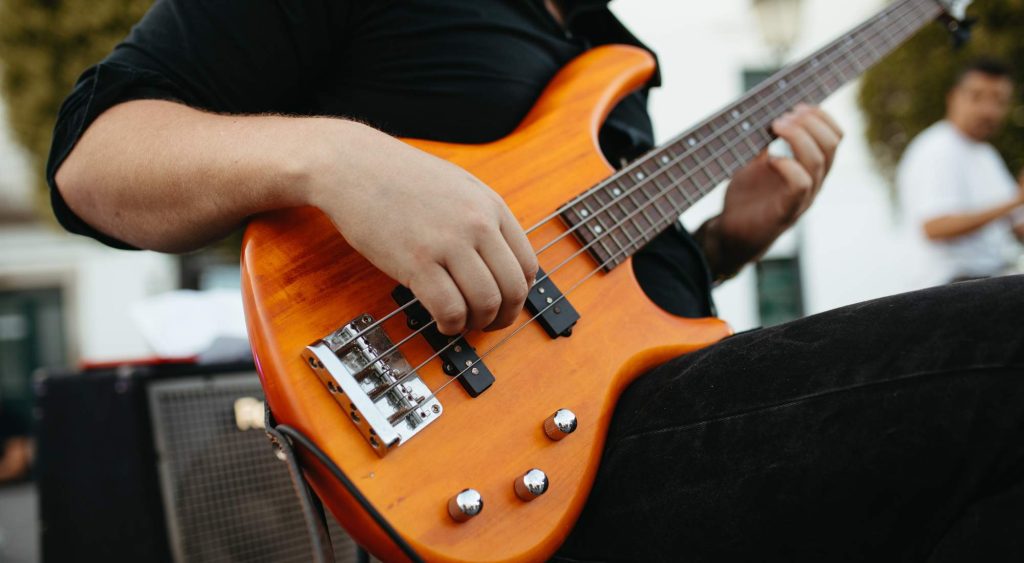
Don’t just focus on being able to play songs, but pay close attention to your technique so that you’ll be able to play any song with skill. Slow down and perfect the various elements of each technique to improve substantially. Whether the technique you are working on is hammer-ons, pull-offs, or strumming, pay attention to these elements:
- Posture
- Hand position
- Speed
- Precision
Rotate your focus points to master each one separately, then put them all together for a drastic improvement in your performance.
#9: Make Use of Dynamics
You can bring a special liveliness to your music through the use of dynamics, allowing your audience to connect with it. Dynamics are variations in volume and tone that contribute to the emotional quality of your playing. Certain techniques – like palm muting and vibrato – also help achieve this effect.
#10: Alternate Your Tuning
Standard tuning (EADGBE) is how six-stringed guitars are typically tuned, but you can set up alternate tuning patterns to play in a different key or to expand the range of chord/riff possibilities.
There are countless ways to alternately tune your guitar. How you do it ultimately depends on the sound you are going for. Open tunings allow you to play chords without pressing down on the frets, so you can just focus on what the picking hand is doing. Drop tuning lowers the pitch of one or more strings.
#11: Work on Improvisation
Improvisation is the guitarist’s way of adding a personal touch to the music. If you are playing in a group, skill in improvising allows you to elaborate on the existing sound in ways that still sound good.
One way to practice this is by choosing a guitar lick to focus on and creating variations on it. You can:
- Change the rhythm of the notes.
- Change some of the notes, but keep the rhythm.
- Change the way you transition between notes.
Become comfortable with improvisation by practicing scales, arpeggios, and chord progressions. You’ll develop an ear for what’s appealing and a greater facility with your hands and fingers to make improvisation more natural to you.
#12: Harness Joy in Your Guitar Playing
Be proud of all the effort you expend on advancing your skills. Remember when you are feeling discouraged, bored, or worn out that the tedium will pay off! When you can finally produce the music you love and impress others with its sound, you’ll have the freedom to enjoy the fruits of your efforts.
Until then, try to appreciate that even the discipline that practice takes can be stimulating — mentally, emotionally, and physically – and humorous, especially if you play with others.

How Long Does It Take To Become an Advanced Guitar Player?
The time it takes to consider yourself truly advanced will depend on:
- How often and how long you practice
- How focused your practice is
- How efficient you are in practice
- Whether you have an instructor or mentor
Do you want to play guitar as a hobby, a casual musician, or a professional? Each level might require some advanced skills, but the higher levels require more of these skills and a greater facility with combining them.
It may take you anywhere between 6 months and 4 years to become a good hobby player and over 10 years to earn professional status. To become a respectable casual musician, your timeframe may lie somewhere in between.
Improve Your Guitar Playing Skills With the Experienced Team at Northwest School of Music in Salem, Oregon
If you would like to learn more about how to become an advanced guitar player and accelerate your progress, contact Northwest School of Music. Our instructors have many years of experience and a degree in performance, music education, or both. We are committed to helping our students become the best musicians they can be, no matter what genre they wish to specialize in:
- Rock
- Classical
- Country
- Blues
- Jazz
- Indie
- Metal
- Folk
Whether you wish to play bass, acoustic, or electric, we have an instructor for you. To learn more about our school in Salem, OR, call us or visit our website, where you can read about our other program offerings and schedule a free trial lesson.



